

I opened three different AI writing tools last week trying to finish a client brief, and none of them behaved the way they did even six months ago. One remembered a style guide I’d uploaded in March. Another rewrote a paragraph and, weirdly, kept my sentence rhythm intact instead of flattening it into the usual AI monotone. That’s when it hit me — the tools themselves haven’t just gotten “smarter” in some vague marketing sense. They’ve quietly changed how people write for a living.
If you’ve searched for ai writing tools updates 2026 hoping for a clear picture of what’s new, what’s hype, and what you should actually use, this is meant to save you the two hours I spent digging through changelogs and product pages so you don’t have to.
Quick Answer
The biggest shift in AI writing tools for 2026 is the move from simple text generation to reasoning-based drafting — tools now plan structure before writing, hold entire documents or manuscripts in memory without losing coherence, and plug directly into everyday apps like Docs, Gmail, and Word. Add sharper SEO guidance, better tone-matching, and built-in fact-checking layers, and you get a generation of writing assistants that feel less like autocomplete and more like a genuinely useful collaborator — though they still can’t replace a human editor’s judgment.
What Does “AI Writing Tools Updates 2026” Actually Mean?
It’s a catch-all phrase, honestly. People use it to search for a few different things: new features rolled out this year, comparisons of which tool got better versus which one stagnated, and whether any of this is worth paying for. There isn’t one single “2026 update” — it’s more of a wave of changes across ChatGPT, Claude, Gemini, Microsoft Copilot, and a handful of specialist platforms like Jasper, Surfer SEO, and Sudowrite, all happening around the same stretch of time.
What ties them together is a shift in philosophy. Earlier AI writing tools were essentially prediction engines — good at finishing your sentence, mediocre at understanding your intent. The 2026 crop leans on reasoning models that think through a structure before they generate a single word. That sounds like a small technical detail, but in practice it means less rambling output and fewer “this reads like it was written by a robot pretending to be a person” moments.
How These Tools Actually Work Now
Here’s the mechanical version, without the jargon overload.
Most AI writing platforms today run on large language models trained on enormous amounts of text, then fine-tuned for specific writing tasks. What’s different in 2026 is the addition of a reasoning layer sitting on top of that base model. Instead of generating text token-by-token in a straight line, the newer systems draft a rough outline internally, check it against your prompt, and then write.
Context windows are the other quiet revolution. A couple of years ago, feeding an AI tool a full book chapter would cause it to “forget” the earlier pages by the time it reached the end. Now, several tools can hold an entire manuscript, or a full quarter’s worth of blog content, in memory at once. That matters if you’re revising a novel, auditing a style guide across fifty articles, or asking a tool to check whether your tone stays consistent from page one to page three hundred.
Then there’s the integration piece. A lot of writing now happens inside the tools people already use — Gmail, Google Docs, Word, Slack — rather than in a separate browser tab. That’s less flashy than “new AI model announced,” but it’s arguably the change that affects the most people day to day.
Main Features Worth Knowing About
A few features keep showing up across the major platforms this year:
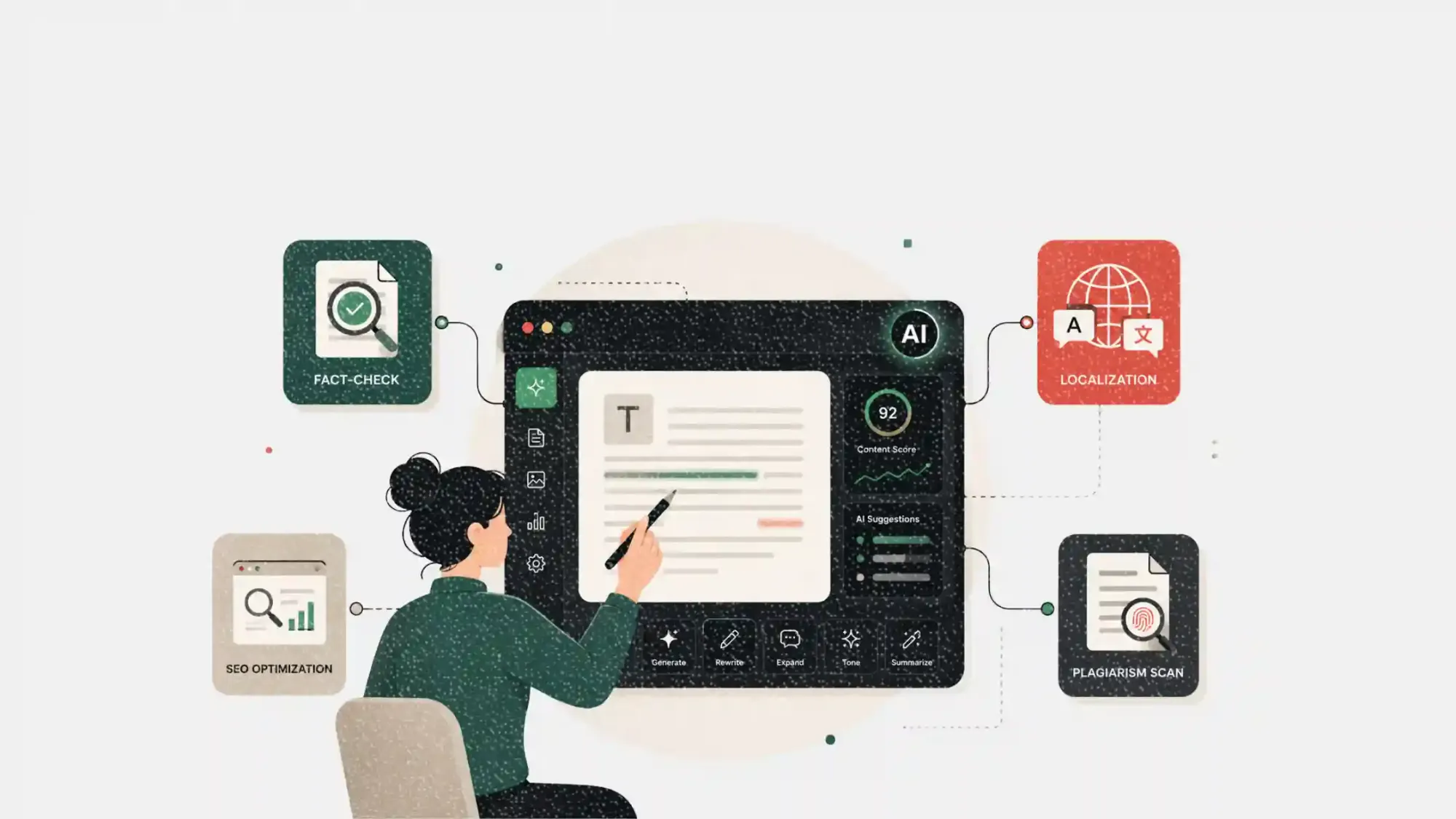
- Tone and intent detection — the tool reads your draft and adjusts suggestions based on whether you’re writing something formal, casual, persuasive, or technical, instead of applying one generic voice to everything.
- Real-time SEO and structure guidance — as you write, tools flag missing subheadings, weak snippet-optimized answers, or thin keyword context, which matters a lot if you’re producing content meant to rank.
- Long-context memory — the ability to hold entire documents, chat histories, or brand guidelines across a session without losing track of earlier details.
- Built-in fact-checking and plagiarism layers — not perfect, but noticeably better at flagging suspicious claims or oddly-phrased sentences that might trip a plagiarism checker later.
- Multimodal input — you can now feed some tools an image, a chart, or a screenshot and ask them to write around it, not just plain text prompts.
- Native app integrations — Google Workspace, Microsoft 365, and Slack all have deeper AI writing hooks built in, so the assistant lives where the writing already happens.
None of these are individually shocking. Taken together, though, they add up to tools that behave less like a novelty toy and more like infrastructure.
Pros and Cons, Honestly
What’s genuinely better:
- Drafting speed has gone from “helpful” to “hard to imagine working without it” for a lot of content teams.
- Long-form coherence has improved enough that reviewing a 3,000-word draft for consistency takes minutes instead of an afternoon.
- SEO guidance is built into the writing process itself now, rather than being a separate step you do after the fact in a different tool.
- Style and brand-voice matching has gotten less clunky — fewer generic corporate-sounding paragraphs than a year or two ago.
What still bugs me, and probably will bug you too:
- Even with reasoning layers, factual errors happen. I still don’t trust any tool’s citations or statistics without checking them myself.
- Pricing has crept up across almost every platform, and the “free tier” on most tools is noticeably more limited than it used to be.
- Output can still sound AI-generated if you don’t edit it — the smoothness sometimes reads as slightly hollow, especially in anything emotional or personal.
- Heavier reliance on these tools means weaker prompting skills go punished harder. A vague prompt in 2026 gets you a vague, if polished, draft.
Real-World Use Cases
A friend of mine runs a small content agency and switched her team’s workflow this year to lean on long-context tools for consistency checks across client blogs — catching contradictions between an article written in January and one written in June that nobody would have caught manually. That’s a genuinely new use case that wasn’t really practical before context windows expanded.
On the fiction side, several authors have started using AI tools purely as structural editors — feeding in full manuscripts and asking for pacing feedback or inconsistency flags, while keeping the actual prose entirely their own. It’s a narrower, more disciplined use than “write my chapter for me,” and it seems to be where a lot of serious writers have landed.
For everyday marketing teams, the pattern I keep seeing is AI handling the first draft and the SEO scaffolding — headers, meta descriptions, keyword placement — while a human writer or editor handles voice, nuance, and anything that requires actual judgment about the audience.
Students, understandably, use these tools for paraphrasing and grammar cleanup more than pure generation, partly because plagiarism detection on the academic side has also gotten stricter this year.
Safety, Privacy, and Legitimacy
This is a legitimate space, not a gray-market trend — the major players here are large, publicly known companies (OpenAI, Anthropic, Google, Microsoft) alongside established SaaS products like Jasper and Surfer SEO. That said, “legitimate” doesn’t mean “risk-free.”
A few things worth knowing:
- Most reputable tools now disclose their data handling policies clearly, and many offer settings to exclude your inputs from training data. Check this before pasting anything sensitive or client-confidential into a tool.
- Enterprise plans generally come with stronger data governance — audit trails, role-based access — while free or personal tiers usually don’t.
- Content originality tools have also improved, which cuts both ways: it’s easier to check your own writing for AI-detection risk, but detection tools themselves remain unreliable and sometimes flag human writing as AI-generated.
- Disclosure expectations are shifting. Several publishers and academic institutions now expect some form of acknowledgment when AI tools were used substantially in a piece of writing. It’s worth checking the norms in your specific industry rather than assuming silence is fine.
None of this means avoid these tools. It means treat them the way you’d treat any third-party software handling your work — read the privacy policy once, and don’t feed them anything you wouldn’t want to see outside your control.
Common Problems and Limitations
Even with all the 2026 improvements, a few frustrations persist:
- Overconfidence in factual claims. The models sound sure of themselves even when they’re wrong, and that hasn’t fully gone away.
- Generic phrasing under pressure. Ask for something highly specific or niche, and you’ll still get filler dressed up in confident language.
- Cost creep. Between subscription tiers, add-on credits, and enterprise pricing, actually running a full AI writing stack has gotten more expensive than the “$20/month” headline pricing suggests.
- Tool fragmentation. Because so many platforms now specialize — one for SEO, one for fiction, one for brand voice — teams often end up juggling two or three subscriptions instead of one.
- Editing fatigue. Drafting is faster, but if you actually care about quality, the editing step hasn’t gotten shorter — it’s just shifted from “writing from scratch” to “fixing AI phrasing,” which is its own kind of tiring.
How the Major Tools Compare
Rather than ranking them arbitrarily, here’s roughly how they’ve settled into different lanes by mid-2026:
- ChatGPT remains the general-purpose default — flexible, decent at almost everything, strong for mixed writing-and-research tasks.
- Claude has leaned into long documents and careful revision, which makes it a common pick for anyone editing lengthy manuscripts or sensitive, nuanced writing.
- Gemini fits naturally if your work already lives inside Google Docs, Gmail, and Workspace.
- Microsoft Copilot does the same thing for Word and the Microsoft 365 ecosystem.
- Jasper stays focused on brand-consistent marketing copy for teams that need a repeatable voice across campaigns.
- Surfer SEO and similar tools specialize in keyword structure and search optimization rather than raw creative generation.
- Sudowrite and fiction-specific tools like Authorflows cater to novelists who want outlining and consistency help without losing authorial control.
The honest takeaway: there’s no single “best” tool in 2026. There’s a best tool for your specific job.
My Practical Take
I’ll be straightforward about where I land on this. The improvements are real — long-context handling alone has changed how I approach editing longer pieces, and the SEO guidance built into drafting saves a genuine step. But I’d push back on any article that tells you AI writing tools in 2026 can replace an editor’s judgment, a writer’s voice, or original reporting. They can’t, not yet, and probably not for a while.
What they’re actually good at is compressing the boring parts of writing — first drafts, structural outlines, consistency checks — so more of your time goes toward the parts that need a human brain: judgment calls, emotional nuance, knowing what your specific audience actually wants to read next. Used that way, the 2026 tools are a legitimate productivity upgrade. Used as a replacement for thinking, they’ll produce competent-sounding content that quietly says nothing.
Final Verdict
If you’re evaluating ai writing tools updates 2026 to decide whether it’s worth switching platforms or paying for an upgrade, the answer depends on what you actually need. If you write long-form content or manage a manuscript, the expanded context windows alone justify trying Claude or a similar long-context tool. If your work lives inside Google or Microsoft’s ecosystem, the built-in integrations are probably the more practical upgrade than a standalone app. And if SEO output is your priority, the newer real-time optimization features are genuinely useful rather than gimmicky.
Just keep editing everything by hand before it goes out the door. That part hasn’t changed, and I don’t think it will anytime soon.
Also Explore Our Guide On This: How-to-connect-airpods-to-laptop
FAQs
Q: What is new in AI writing tools in 2026?
A: The main changes are reasoning-based drafting that plans structure before generating textindows that hold full documents or manuscripts, built-in real-time SEO guidance, and deeper integration into everyday apps like Docs, Gmail, and Word.
Q: Are AI writing tools accurate in 2026?
A: They’re noticeably more accurate than earlier versions thanks to improved reasoning models, but factual errors still happen. Always verify statistics, quotes, and claims independently before publishing.
Q: Can AI writing tools replace human writers?
A: No. They speed up drafting and structural work, but judgment, original reporting, emotional nuance, and voice still require a human writer or editor.
Q: Which AI writing tool is best for long documents?
A: aude is generally considered the strongest option for long-form work in 2026 due to its expanded context window and consistency handling across lengthy manuscripts.
Q: Is it safe to use AI writing tools for sensitive or confidential content?
A: Reputable tools disclose their data policies and often let you opt out of having your inputs used for training, but it’s still wise to avoid pasting highly sensitive or confidential material into any third-party tool, free or paid.
Q: Do I need to disclose that I used an AI writing tool?
A: It depends on your industry and platform. Some publishers and academic institutions now expect disclosure when AI tools contributed substantially to a piece of writing, so it’s worth checking your specific field’s norms.
Q: Are AI writing tools good for SEO content in 2026?
A: Yes — most major tools now include real-time SEO guidance, keyword context suggestions, and structure recommendations built directly into the drafting process, which makes them genuinely useful for content meant to rank in search.
